3/8" Crushed Stone: the Finish Course Over an Ohio Base
A common Ohio mistake is treating 3/8" Crushed Stone as driveway support when it is better used for a smooth, compacted finish.
- Size: Approximately 3/8 inch
- Type: Angular crushed stone
From $394 for 1 ton, delivery included (larger loads cost significantly less per ton)
Free delivery included
Free delivery anywhere in Ohio
Pick a delivery date
Weekday delivery, earliest Oct 23
“This was a useful size for a narrow side path. It looked neat, felt stable, and was manageable to spread. I was pleased with how well it fit the project at my home in Columbus, OH.”
Reese F. · Verified Buyer
Get a Free Quote
Fill out the form and our sales team will get back to you within the hour.
Size and Grading
- Size
- Approximately 3/8 inch
- Type
- Angular crushed stone
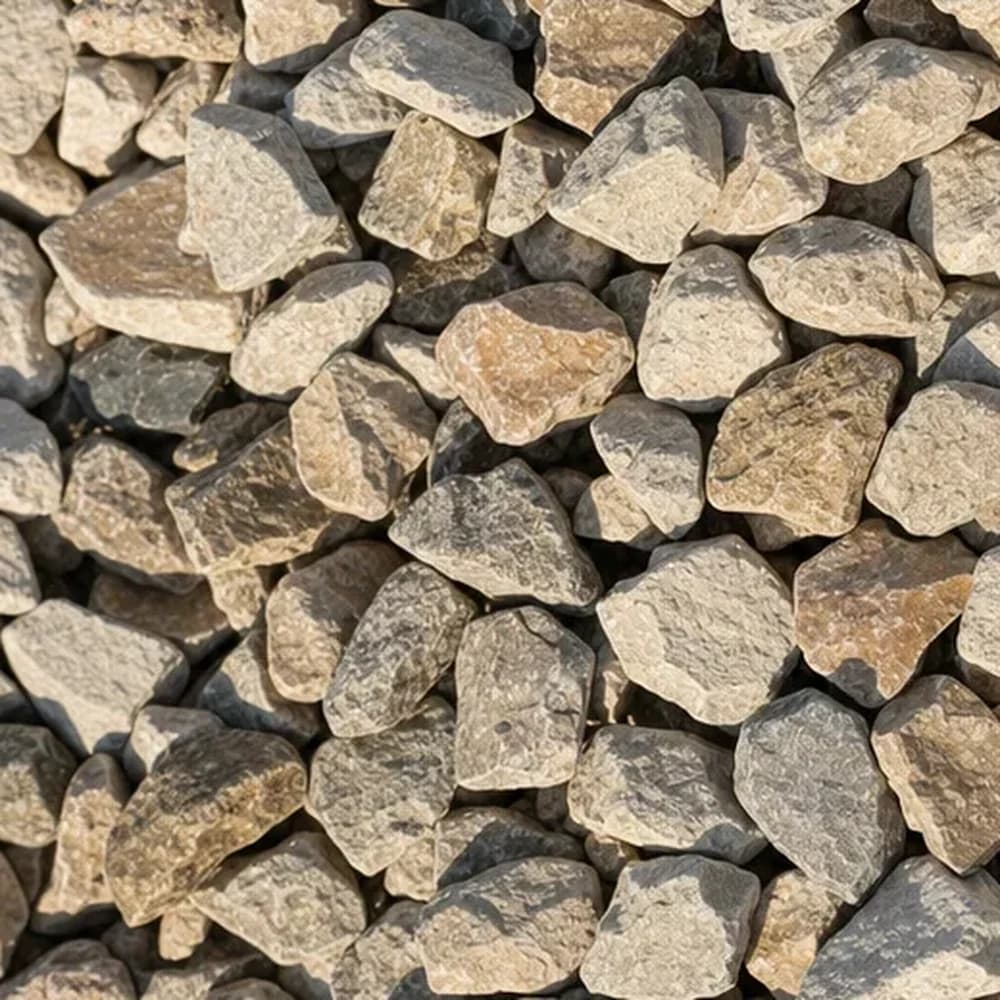
By the time most Ohio orders for 3/8" crushed stone go in, the hard work is already done. There is a compacted base sitting in the drive or under the patio, it has been rolled, and it is rough. Big pieces stand proud, the surface throws stone at the mower, and the last inch of the job is the one nobody planned for. This is the material that goes on top of that: angular chips at roughly 3/8 inch, small enough to fill the hollows between base stones and fine enough to walk on barefoot at the back door.
The problem it solves sits on top of a rolled base, not under it
A base course does the carrying. It is built from a spread of sizes that wedge together under a roller, and it is meant to be covered. Left bare on a drive it ruts at the wheel tracks and works loose at the surface, and left bare under a flagstone it never sits quite flat. A dressing course of small angular stone knits down into the top of that base, closes the surface and gives you something even to walk, park and look at.
| Spec | Figure |
|---|---|
| Size | Approximately 3/8 inch |
| Type | Angular crushed stone |
One local point worth having before you order. Ohio yards more often sell this size by number than by inch, so if you ask around the state for a 3/8 inch stone you will usually be handed the number grade instead. On this site both are stocked, and #8 crushed stone is the washed clean version of much the same size band.
How a thin top layer behaves on lake plain clay and on a gravel knoll
Everything a 3/8 inch layer does depends on what is beneath it. On the flat lake plain of the northwest, where spring rain and snowmelt sit on heavy clay until ditches and field tile take them away, a thin stone layer over soft ground is a sponge with a lid. It will press into the clay, disappear in patches, and look thin again by the second season. The base and the grade are what fix that, not more stone on top.
On a sand and gravel knoll on the northeast plateau, or in a river valley where outwash drains freely, the same layer sits still and lasts. Same product, completely different result, and the ground is the variable. Freeze-thaw runs through both: water trapped under a finish course lifts it in winter, so the fall across the surface matters as much as the depth of it.
Laying it over a rolled base, and bedding a utility line
On a drive, roll the base first and check the crown so water sheds to the edges rather than standing in the middle. Spread the stone about an inch to an inch and a half deep, rake it out to a consistent thickness, then tamp or drive it in. A deeper dressing course is not a better one. Piled on thick it stays loose, moves under tires and windrows into ridges at the edges.
Around a utility line, the job is different. Here the small angular size is doing the work of getting in under and around an awkward shape without a void behind it, so bring it up in lifts either side of the pipe or conduit and settle each lift before the next.
A pond edge, a construction entrance and a patio base all point elsewhere
Three jobs get typed into this page by mistake in the same week.
A pond or shoreline edge is a water-energy problem. Spring storm runoff off the southeast hills and wave action on a Lake Erie frontage will pick a 3/8 inch chip up and move it in one season, so that edge wants RipRap sized to the flow hitting it.
A construction entrance is a load problem. It needs stone big enough to flex under a loaded axle and shed mud before the road, which on Ohio sites means #4 crushed stone, or railroad ballast where the ground under it stays wet.
A paver patio base is a structure problem, and it is three layers rather than one. Compacted 304 limestone carries the load, mason sand or screenings bed the units, and 3/8 inch stone belongs on the finished side of that build, dressing a gravel border or the gaps between stepping stones.
Raking, topping up, and what the first freeze and thaw does
A finish course is consumable in a way a base is not. Expect to pull it back off the lawn edge with a rake once a year, and expect a top-up load in the third or fourth season on a drive that gets daily traffic and winter plow work. Plow blades are harder on a dressing course than winter itself is; a shoe on the blade saves most of it.
The first freeze and thaw run tells you whether the drainage below is right. A surface that comes through spring tight and even is sitting on ground that drained. Soft patches that reappear in the same places every March are a subgrade message, not a stone message.
What a 10 by 70 drive takes as a dressing course
Take a hypothetical single-car drive, 10 feet by 70 feet, dressed an inch and a half deep over an existing compacted base.
- Area: 10 x 70 = 700 square feet
- Depth: 1.5 inches = 0.125 feet
- Volume: 700 x 0.125 = 87.5 cubic feet
- Cubic yards: 87.5 / 27 = 3.2 cubic yards
- Tons at about 2,800 lb per cubic yard, or 1.40 tons per yard: 3.2 x 1.40 = 4.5 tons
Five tons is the order for that drive, with the spare going into the apron where the stone always thins first. A hypothetical 35 foot service trench at 12 inches wide with 6 inches of bedding works out at 35 x 1 = 35 square feet, 17.5 cubic feet, 0.65 cubic yards, or about 0.9 tons.
Run your own measurements through the stone calculator, then choose a quantity and a delivery date on this page. Delivery is arranged at checkout from your ZIP code, and the truck needs clear access to a spot where the bed can go up. Dropping the pile at the top of a drive and working down beats the reverse every time.
Quickly Calculate How Much You Need
Material: 3/8" Crushed Stone
How to Measure
Measure the length and width of your project area in feet
Decide on depth in inches (2" for landscaping, 4" for driveways)
Enter the values above and we'll calculate the tonnage you need
Need help figuring out the right amount? We can help!
Call or text us at (216) 247-5333 and we'll help you calculate the right quantity for your project.
Not sure how much you need? The Stone Calculator has depth guides, coverage charts and worked examples for this material.
Frequently Asked Questions About 3/8" Crushed Stone
Customer Reviews
Got crushed stone from them and I'm really happy with it. Free delivery was a nice bonus too.
Diane E. · Cincinnati, OH · Verified Buyer
Ordered crushed stone from the team, they kept me updated the whole time and the price felt really fair.
Luis J. · Toledo, OH · Verified Buyer
Got crushed stone from them and the price felt fair for what I got. They kept me updated the whole time, and everything showed up when they said it would.
Jason R. · Akron, OH · Verified Buyer
Ordered crushed stone from these guys and they kept me updated the whole time. Free delivery was a nice bonus, and everything showed up right when they said it would.
Dana W. · Cincinnati, OH · Verified Buyer
Neat material for a side path
This was a useful size for a narrow side path. It looked neat, felt stable, and was manageable to spread. I was pleased with how well it fit the project at my home in Columbus, OH.
Reese F. · Dayton, OH · Verified Buyer
3/8" Crushed Stone has 5 verified customer reviews with an average rating of 5 out of 5.