Fill Dirt Calculator: Yardage for Sunken Ohio Ground
Enter your project dimensions
Most fill dirt orders in this state begin with a tape measure and a dip that will not drain. Flat till and lake plain clay hold spring water until field tile or a roadside ditch takes it off the field, so a hollow sitting two inches below everything around it stays a puddle through April, and every winter freeze-thaw crumbles the rim a little wider. The awkward part is the arithmetic. A shape with no straight edges and no single depth still has to come out as cubic yards before anyone can order against it.
Measuring a Hollow That Has No Straight Edges
A settled lawn area is not a box, but it can be entered as one. Walk the edge where the ground stops being level and drive a stake at each corner of the smallest rectangle that contains it. That rectangle is your length and width, and the extra you have included around the edges is the feather-out you were going to need anyway.
Depth is the part people get wrong. Lay a straight board across the hollow from firm ground to firm ground and measure down to the soil at the deepest point, then again near the rim. Average those two. A hollow 19 by 15 ft that is 7 inches down in the middle and an inch at the edge averages 4 inches.
That gives 285 sq ft. Multiply by 4 ÷ 12 and the volume is 95 cubic feet, which is 95 ÷ 27 = 3.52 cubic yards, and at 1.20 tons per yard it comes to about 4.2 tons of dry fill.
Feeding an Average Depth Into the Fill Dirt Calculator
Shape first: rectangle, circle, or up to five areas added together when the low ground comes in more than one patch. Length and width go in feet, a circle takes its diameter in feet, and depth goes in inches, anywhere from 0.25 up to 24. Select the material so the tonnage matches, leave the box that adds 10 percent for compaction and spillage ticked, and calculate. Cubic yards, tons and cubic feet all appear together, and the results panel will email them to you.
Anything deeper than 24 inches has to go in as two runs. A 3 ft deep hole is entered twice at 18 inches, or once at 24 and once at 12, and the two figures added. That comes up often on old stump holes and collapsed cistern tops.
How Deep the Raise Has to Be, Job by Job
- Settled lawn hollows. Fill to average depth, then leave the surface about half an inch proud of the surrounding grade so it settles flush rather than back into a dish.
- Utility trenches. Measure the void, not the ground surface. Length, width and the depth from the bottom of the open trench to where the grade should finish.
- Berms. The cross section is a triangle, not a rectangle, so the average depth is roughly half the height at the ridge.
- Raising ground before a base goes down. Bring the fill to the level the stone will sit on, then calculate the 304 limestone separately on its own tool.
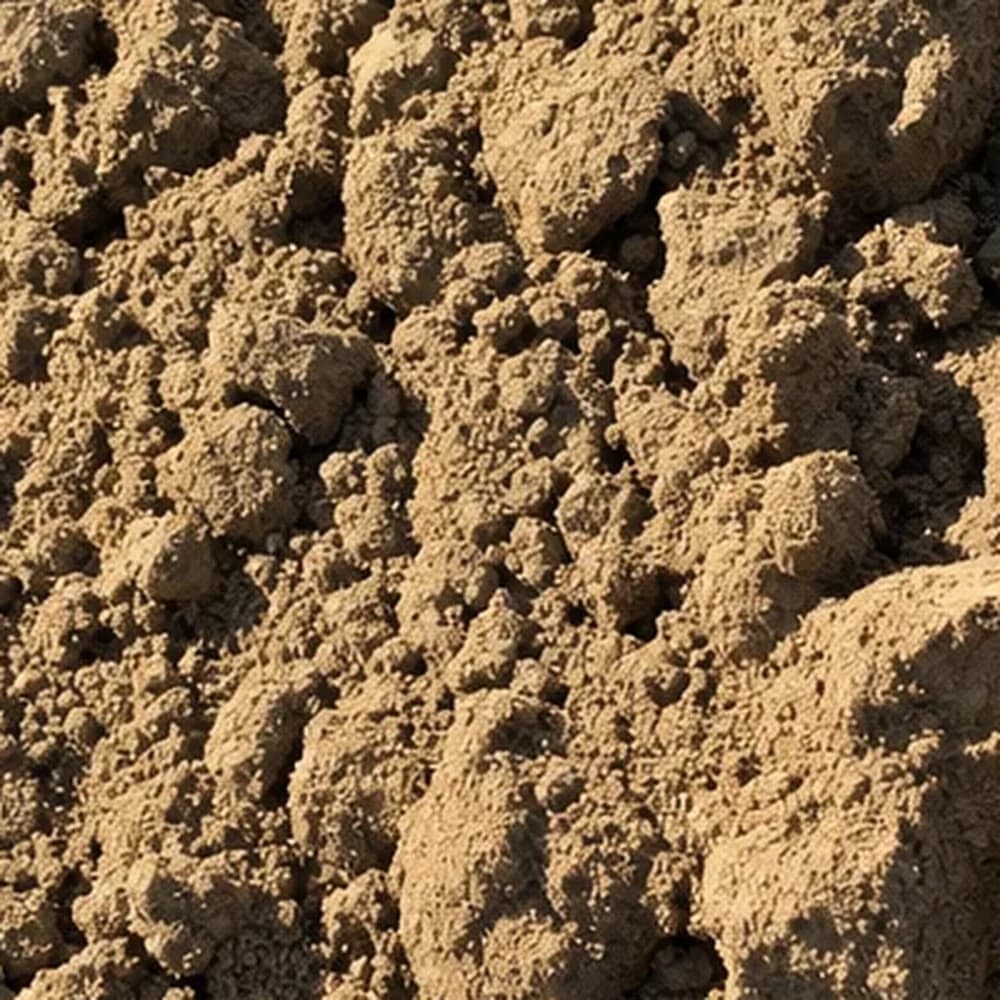
- Growing areas. Stop the fill 4 to 6 inches below finished grade and cap it with screened topsoil. Fill dirt is subsoil with the organics screened out; it holds a grade and it does not grow anything.
Place it in 6 to 8 inch lifts and compact each one, or at minimum soak each lift and give it time. Deep fill under a slab or a footing needs thinner lifts and an engineer's compaction figure, which is outside what this page can size.
Dry Fill at 1.20, Wet Fill at 1.50
| Material | Weight per cubic yard | Tons per cubic yard |
|---|---|---|
| Fill dirt, dry | about 2,400 lb | 1.20 |
| Fill dirt, wet | up to 3,000 lb | 1.50 |
| Screened topsoil, for comparison | about 2,200 lb | 1.10 |
Rain changes what a yard weighs, not how many yards the hole takes. The volume you ordered is still the volume you need. What the weight changes is the day: saturated clay fill smears instead of compacting, and a wheelbarrow of it at 3,000 lb per yard is a different proposition from the same wheelbarrow dry. Watch the forecast, tarp the heap before a storm, and spread on a drying day.
A Settled Trench and a Berm, With the Arithmetic
Backfill over a settled utility run. A line 40 ft long that has sunk into a 2.5 ft wide band, averaging 8 inches down. Area is 100 sq ft. Volume is 100 x (8 ÷ 12) = 66.7 cubic feet, which is 2.47 cubic yards, and at 1.20 that is 3.0 tons. With the 10 percent box it reads 2.72 yards and 3.3 tons. Fill a trench like this in two lifts with a good soaking between them, because a single deep lift is what dropped it the first time.
A screening berm along the road edge. A mound 22 ft long and 5 ft wide at the base, standing about 28 inches at the ridge, so the average depth across the footprint is roughly 14 inches. Area is 110 sq ft. Volume is 110 x (14 ÷ 12) = 128.3 cubic feet, or 4.75 cubic yards, which is 5.7 tons. Order a little over: a berm loses height for a season as it settles and you will want to shape it twice.
Both of these are worked examples with invented dimensions, not projects.
Fill Dirt, Topsoil or Garden Soil: Which Tool You Actually Want
Three calculators on this site look similar and answer different questions, which is worth thirty seconds before you enter anything.
- This page and Fill Dirt are for the structural build-up: holes, trenches, berms, grade changes, anything below the growing layer.
- The topsoil calculator is for the 4 to 6 inch cap that grass and beds root in, at 1.10 tons per yard.
- The soil calculator covers the blended Garden Soil that goes into raised beds, at 1.00 ton per yard.
A lawn repair usually needs two of them: fill to within 4 to 6 inches, then topsoil over the top. Run each depth in its own tool and order both together from Ohio Rock Supply so one delivery covers the job. Delivery is arranged at checkout by ZIP code, and the truck needs a firm place to tip that is not the soft ground you are about to fill.
Common questions
Does leaving the compaction and spillage box ticked mean I can skip the lifts and the soaking?
Not on its own. The box is there for spillage and what stays in the heap. Settlement is handled by how you place the material, which means 6 to 8 inch lifts, compaction or a thorough soak on each one, and leaving a lawn patch half an inch high. If the fill is going in loose with no compaction at all, order above the calculated figure and expect to top it up after the first hard rain.
A wash running down a southeast Ohio hillside gets deeper as it drops. What depth do I enter?
Take three or four readings down the slope with a board and a tape, from the top of the wash to the bottom, and average them. A slope usually needs more at the low end and almost nothing at the top, so a single mid-point reading will either over-order or leave the bottom short. On a steep southeast Ohio hillside, also check that what you are filling is a wash rather than the start of a slip.
Can I put both sunken lane shoulders into one calculation when they are not the same depth?
Yes. Use the multiple-areas option and enter each one as its own rectangle with its own depth, up to five at a time, and the tool adds the volumes. Keeping them separate is the point, since the patches will rarely be the same depth and averaging across both would misstate each.
The 40 ft trench needs a foot or two of taper each side. Is that extra area part of the order?
Include it. Fill that stops in a vertical edge slumps and washes at the joint, so a foot or two of feather-out on each side is part of the work, and on a 40 ft trench that is another 80 to 160 sq ft of area at a shallow depth.
The lawn patch needs fill at 1.20 tons and topsoil at 1.10. How do I get both figures from one footprint?
Run the same footprint twice. First at the depth from the current ground to 5 inches below finished grade, on fill dirt at 1.20 tons per yard, then at 5 inches on topsoil at 1.10. Order them as two products. Getting that sequence right matters, because topsoil buried under a foot of fill does no work down there.
Related calculators
Cheap by the yard, free to your gate.
Screened fill dirt for grading and backfill, delivered across Ohio.