Road Base Calculator: 304 Limestone at Compacted Depth
Enter your project dimensions
Base work in this state gets done in the window between a drained spring and a hard fall, because saturated clay will not compact and frozen clay will not compact either. Inside that window the jobs are not the same size, and the road base calculator is where that becomes obvious. Two pieces of the same property, both needing 6 inches of stone, can be an afternoon apart on the ground and ten times apart on the truck.
Ten by Twenty Behind the Garage, Then Two Hundred Feet to the Barn
Take a 10 by 20 foot pad behind the garage. The area is 200 square feet, the volume is 200 x (6 / 12) = 100 cubic feet, that is 100 / 27 = 3.70 cubic yards, and at 1.50 tons per yard it comes to 5.6 tons. One tip, one afternoon with a rake and a plate compactor.
Now the lane running back to the barn: 200 feet long and 11 feet wide, at the same 6 inches. Area 2,200 square feet, volume 2,200 x 0.5 = 1,100 cubic feet, which is 40.7 cubic yards and 61.1 tons. Same depth, same material, eleven times the order, and a job that wants a box blade or a skid steer rather than a wheelbarrow. These are made-up dimensions used to show the arithmetic, but the gap between them is the real point: on a lane, an inch of depth guessed wrong is measured in tons.
Before either job starts, strip the organic layer. Base placed over topsoil lets the clay work up into the stone, and no amount of extra tonnage fixes that. On the wet lake plain in the northwest, or anywhere the ground has already rutted, woven geotextile between soil and stone keeps the two apart.
Feeding the Road Base Calculator a Lane, an Apron or a Pad
For a lane, measure the centerline and take an average width, since lanes widen at the gate and pinch between trees. For a pad, length by width. Both go in as feet. Circle mode takes a diameter in feet and suits a turnaround or a bin pad. Multiple areas holds up to five footprints and totals them, which is how a lane and its apron get ordered together without either one being averaged away.
Depth goes in as inches, anywhere from 0.25 to 24, and it should be the finished compacted depth:
- 4 inches for light residential traffic on firm, drained ground.
- 6 inches for daily vehicles and delivery trucks.
- 8 to 12 inches under equipment, containers, or across soft clay subgrade.
Select the material so the tons are figured on the right weight, then check the one allowance control: a box, ticked by default, that adds 10 percent for compaction and spillage and can be unticked. Press calculate and cubic yards, tons and cubic feet all appear together, with the option to have them emailed.
Cubic Feet In, Tons Out at 1.50
Road base is published here at about 3,000 lb a cubic yard, which is 1.50 tons. That figure is for loose material on the truck; once it is rolled, the same tonnage occupies less depth on the ground. The arithmetic runs length x width x (depth in inches / 12) for cubic feet, divided by 27 for cubic yards, multiplied by 1.50 for tons.
| Compacted depth | One ton covers | Tons per 100 feet of a 10 foot lane |
|---|---|---|
| 4 inches | about 54 sq ft | 18.5 |
| 6 inches | about 36 sq ft | 27.8 |
| 8 inches | about 27 sq ft | 37.0 |
| 12 inches | about 18 sq ft | 55.6 |
That right-hand column is the one to keep in view when a lane is involved. Adding a foot of width to a 300 foot drive is not a trim adjustment.
Rounding Up When the Weather Window Is Short
The box on the form adds 10 percent. Read it as cover for spillage and for what stays in the heap, not as a compaction allowance, and enter the compacted depth you actually want rather than leaving the box to make up the difference. Place the stone in lifts of 4 inches or less and roll each one before the next goes down, and build a 2 to 3 percent crown off the centerline so rain leaves the surface instead of soaking into the base.
Coming up short on a lane costs more here than ordering long. A half-built base sits open to the next rain, the clay underneath softens, and the compaction you were counting on stops being possible until the ground dries out again. Round to the next sensible figure and keep the surplus for the ruts that show up after the thaw. Two drop points along a long run also beat one heap at the gate, since the material then has less distance to travel.
304 Below, and What Goes On Top of It
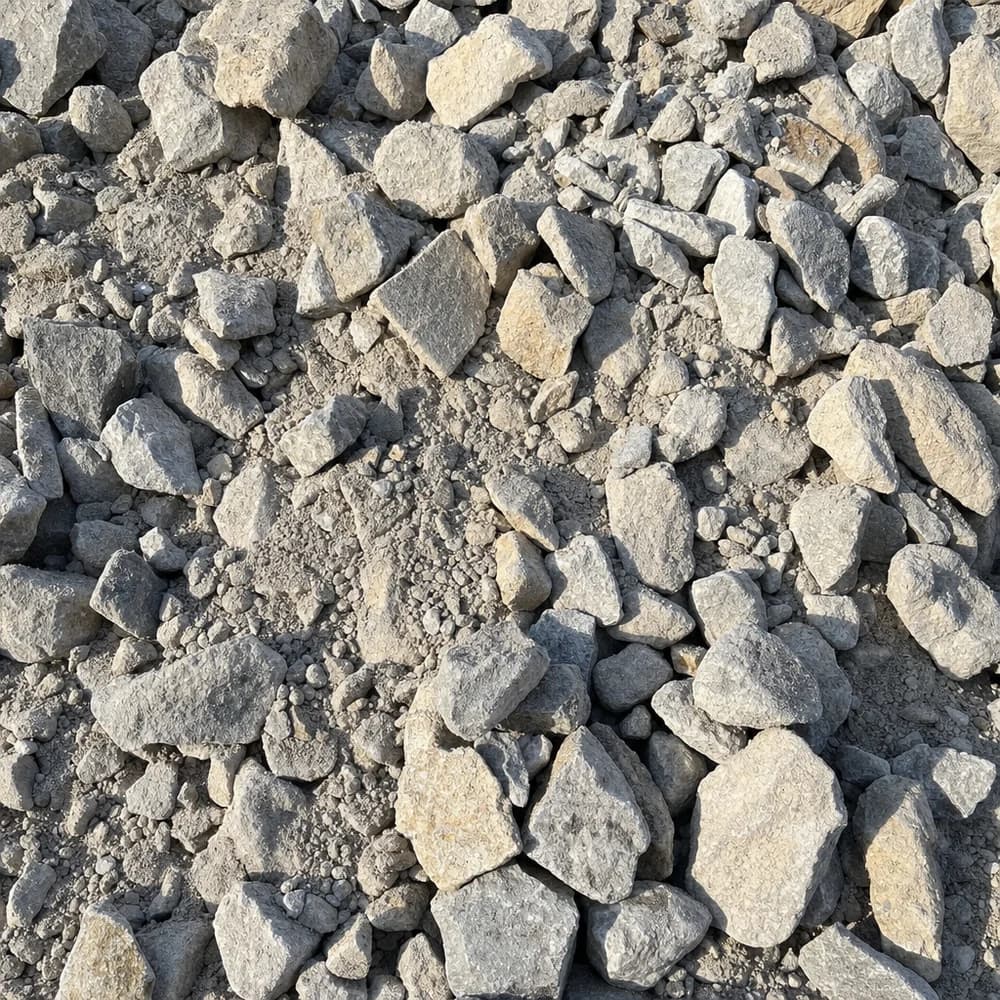
304 limestone is the Ohio base course, specified by ODOT as Item 304 and sold here as 304 Aggregate Base. It carries a larger top stone for load support and is what goes under a drive, a pad or a lane. 411 limestone is finer, grades out smoother, and is the driveway topping and paver bedding material rather than the structural layer, and it has a tool of its own. Both sit on the same 3,000 lb line, so switching between them changes the surface, not the tonnage.
Above the base, a neat driving finish usually means 2 to 3 inches of #57 limestone or driveway gravel, calculated separately on the gravel calculator at 1.40 tons per yard. Recycled crushed concrete base compacts and carries load in much the same way where a specification allows it, and the quantity arithmetic does not change. Where a county specification calls for virgin aggregate, follow the specification.
Once you have a tonnage, open the product page, set the quantity and choose a date. Delivery is arranged at checkout by ZIP code, and the truck needs clear access to a firm place to tip.
Common questions
The approach climbs from the road up to the barn. Which length goes in the box?
The length measured along the surface of the climb, taken with a tape on the ground. A slope always runs longer than the flat distance it covers, and on a rise of any consequence the difference is worth several tons. Take the width at the bottom, the middle and the top as well, then average them, because an approach usually flares where it meets the road.
The pad and the turn-in are two different widths. Can the tool add them?
Yes. Use the multiple areas option and enter each as its own rectangle with its own depth, up to five at a time, and the totals are combined for you. Keep them separate rather than averaging: a turn-in that carries the same trucks as the pad often wants 8 inches where the pad is fine at 6, and averaging hides that.
Does the loose stone that spills past the edge of the lane count?
Include a shoulder. A lane finished with a vertical edge loses stone off both sides through the first winter, so plan on a foot of taper each side and add that to the width you enter. On 200 feet of lane that is another 400 square feet at a shallow depth, which is real tonnage and better ordered than borrowed from the middle.
How do I order 304 underneath and a top course separately?
Run the same footprint twice. First at the base depth with road base selected, then at 2 to 3 inches with the surface material selected, and buy the two figures as two products. Entering one combined depth gives a correct total and a useless split, and the two materials will not be tipped in the same heap anyway.
The apron flares out where it meets the township road. What do I enter for a shape like that?
Break it into pieces the tool understands. A flare is close enough to a triangle, so take its average width, which is roughly half the width at the road, and enter it as a rectangle of that average. Anything curved can be handled the same way, or squared off to the rectangle that contains it if you would rather have the surplus than the guesswork.
Related calculators
Thirty tons. Zero delivery fees.
Road base priced per ton, hauled free, at lane quantities where hauling usually costs the most.