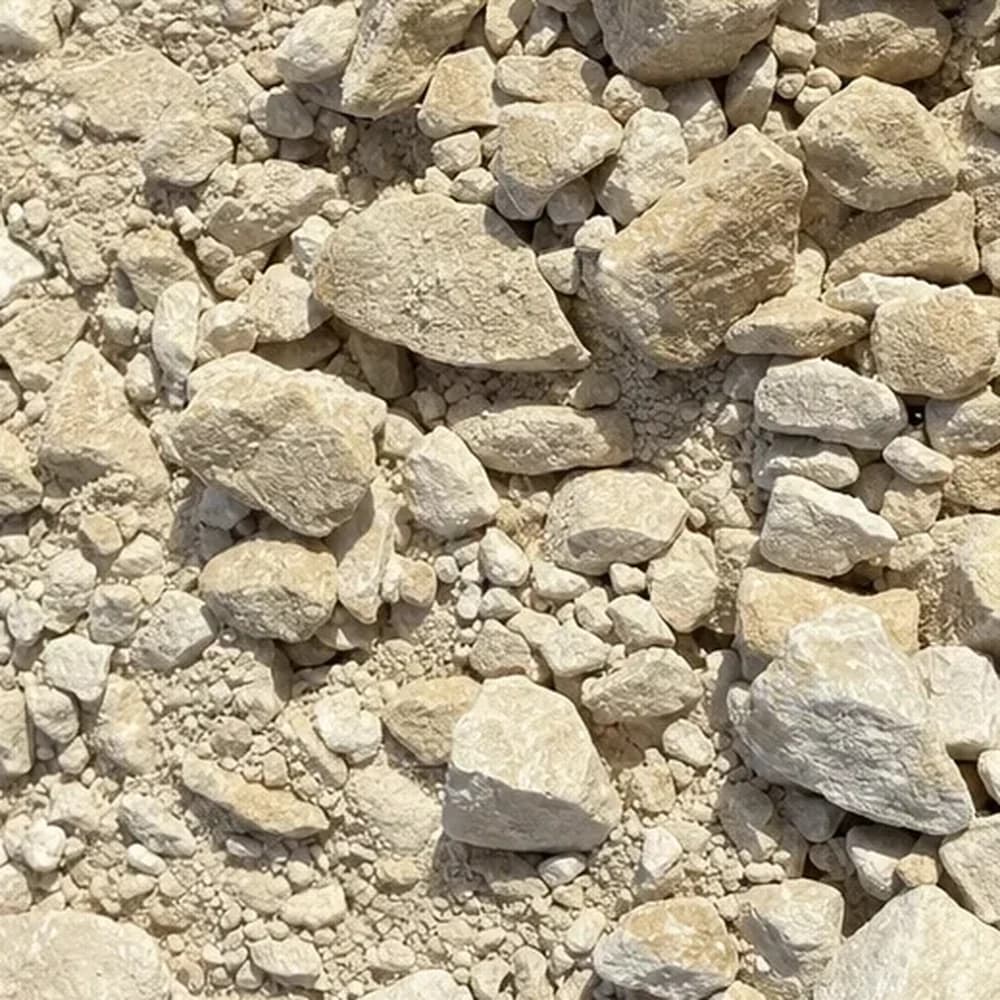
Crusher Run Calculator: 411 Limestone at Its Rolled Depth
Enter your project dimensions
Ohio base work runs on a window rather than a calendar. Frozen or saturated clay will not take compaction, so the rolling happens once the ground has thawed and dried in spring and finishes in late fall, and inside that window a half-built pad left open through a wet week is a worse problem than no pad at all. That is the real argument for getting the order right before the plate compactor comes out, and it is what the crusher run calculator on this page is for.
A Shed Pad and a Farm Lane, Off the Same Tool
Two jobs that both call for 411 limestone can sit at opposite ends of the order sheet.
A 12 by 16 ft shed pad at 4 inches compacted covers 192 sq ft. Multiply by 4 ÷ 12 and the volume is 64 cubic feet, which is 64 ÷ 27 = 2.37 cubic yards, and at 1.50 tons per yard that is 3.6 tons. Leave the extra box ticked and it reads 3.9. One person with a wheelbarrow and a rented compactor can place that between breakfast and dark.
A 400 ft farm lane 10 ft wide at 6 inches compacted covers 4,000 sq ft. Multiply by 0.5 ft and the volume is 2,000 cubic feet, or 74.07 cubic yards, which comes to 111.1 tons, or 122.2 with the extra box. That is equipment work, staged over several days, and the spreading has to be planned before the first load arrives.
Same material, same arithmetic, two orders thirty times apart. The gap is why guessing by eye stops working the moment a job gets longer than a patio.
What the Crusher Run Calculator Wants in the Depth Box
The depth field takes the finished compacted thickness, not the loose heap you tip out of the wheelbarrow. 411 limestone tightens by roughly 10 to 15 percent as it is rolled, so a layer spread 4 inches loose finishes near 3.5. Every base figure worth quoting is a compacted figure.
The rest of the form is short. Choose a rectangle, a circle, or up to five areas added together for a lane that changes width. Length and width go in feet, a circle takes its diameter in feet, and depth goes in inches anywhere from 0.25 to 24. Pick the material so the weight matches, leave the box that adds 10 percent for compaction and spillage ticked, and press calculate. You get cubic yards, tons and cubic feet at once, and there is an email option on the results panel if you want the figures in writing before you order.
Compacted depths worth entering: 4 inches under a walk or a paver patio, 4 to 6 inches under a drive that carries cars, 6 to 8 inches where a truck or a tractor turns, and 4 inches over stripped ground for a barn or equipment pad, going to 6 on soft ground.
Cubic Feet, Yards, and the 1.50 That Follows
The volume half never changes: length in feet times width in feet times depth in inches divided by 12 gives cubic feet, and 27 cubic feet make a cubic yard. The weight half is where the material matters. 411 limestone carries its own crusher fines, and those fines fill the voids between the stones, so a cubic yard runs about 3,000 lb. That is 1.50 tons per yard, the heaviest line on this site apart from RipRap.
| Compacted depth | One cubic yard covers | One ton covers |
|---|---|---|
| 2 inches | 162 sq ft | about 108 sq ft |
| 4 inches | 81 sq ft | about 54 sq ft |
| 6 inches | 54 sq ft | about 36 sq ft |
| 8 inches | 41 sq ft | about 27 sq ft |
Checking one line by hand: a cubic yard is 27 cubic feet, and 27 ÷ (4 ÷ 12) = 81 sq ft at 4 inches. Divide that by 1.50 and a ton covers 54.
Why an Ohio Base Order Should Land Long
The 10 percent box covers spillage and the material that never leaves the pile. It does not cover the ground. On lake plain and till plain clay the subgrade gives a little under the first passes, and some of your base disappears into it, which is why a woven geotextile, sourced from a landscape supplier rather than from this catalogue, goes down first on soft clay. Coming up two tons short on a 6 inch lane means the last stretch sits at the wrong level until another load arrives, and if that gap lands in a wet spell the open subgrade turns to soup.
Round up. A leftover heap under a tarp is the material you patch ruts with after the spring thaw, and 411 limestone is what pothole patching is done with anyway. Ohio Rock Supply sells it by the ton, so rounding to the next half ton is a small decision.
411 Limestone Here, 304 Limestone on the Other Tool
This page sizes the compacted crushed course, specified locally as ODOT Item 411, which is what most gravel drives wear on top and what pavers bed over. If what you are building is the aggregate base course underneath it, Item 304, use the road base calculator instead and order 304 Aggregate Base. The weight is the same 1.50, so the tons will match for a given depth; keeping the two runs separate is what lets you set 6 inches below and 2 inches above without doing the sum twice.
One place 411 limestone does not belong is a drain. The fines that make it compact are the same fines that hold water, so a French drain or a downspout run wants clean stone such as #57 limestone or drain rock with nothing fine in it. For a travel surface over a finished base, driveway gravel or #57 spread 2 to 3 inches deep is the usual Ohio answer.
Taking the Tonnage to the 411 Stone Page
Carry the calculated figure to 411 Stone, set your quantity and pick a date that falls in dry weather, since damp material compacts tighter than dust-dry material but saturated clay underneath will not compact at all. Delivery is arranged at checkout by ZIP code, and the driver needs a clear run to a firm spot where the load can be tipped without crossing the new work. If the pad is going in the middle of a field, say so on the contact page before you order.
Common questions
My lane climbs a hill. Do I measure the slope or the flat distance?
Measure along the surface you are going to drive on, not the map distance, by running a tape down the lane itself. On a moderate grade the difference is a couple of percent; on a steep cut into a southeast Ohio hillside it can be closer to ten, and that is stone you would otherwise be short.
The parking area is L-shaped around the barn. How do I enter it?
Split it where the corner turns and use the multiple-areas option, up to five at a time. Enter each leg as its own length and width and let the tool add them, and count the corner square once rather than in both legs. Keep the same depth across all of them if it is one continuous surface.
Should the stone shoulder either side of the drive go in the calculation?
Yes, if you intend to build it. A drive that ends in a clean vertical edge loses stone off the sides under traffic, so most Ohio lanes get a foot of shoulder each side tapering out. On a 400 ft lane that is 800 sq ft of extra area, which is not a rounding error.
I need 304 below and 411 on top. One order or two?
Two calculations, one delivery. Run the footprint once at the base depth and once at the topping depth, order each product for its own figure, and have them dropped together so the second layer is on site when the first is rolled. Both weigh 1.50 tons per cubic yard, so only the depth changes between the two runs.
The pad has a curved front edge. What do I put in the box?
Box the curve in and accept the small over-estimate, or split the shape into a rectangle plus a half circle and use two areas. Entering the full circle diameter and halving the result by hand also works. The surplus goes into the shoulder or the heap you keep for patching.
Related calculators
Base tonnage sorted? Good.
Crusher run by the ton, the cheapest structure on the yard, delivered free.