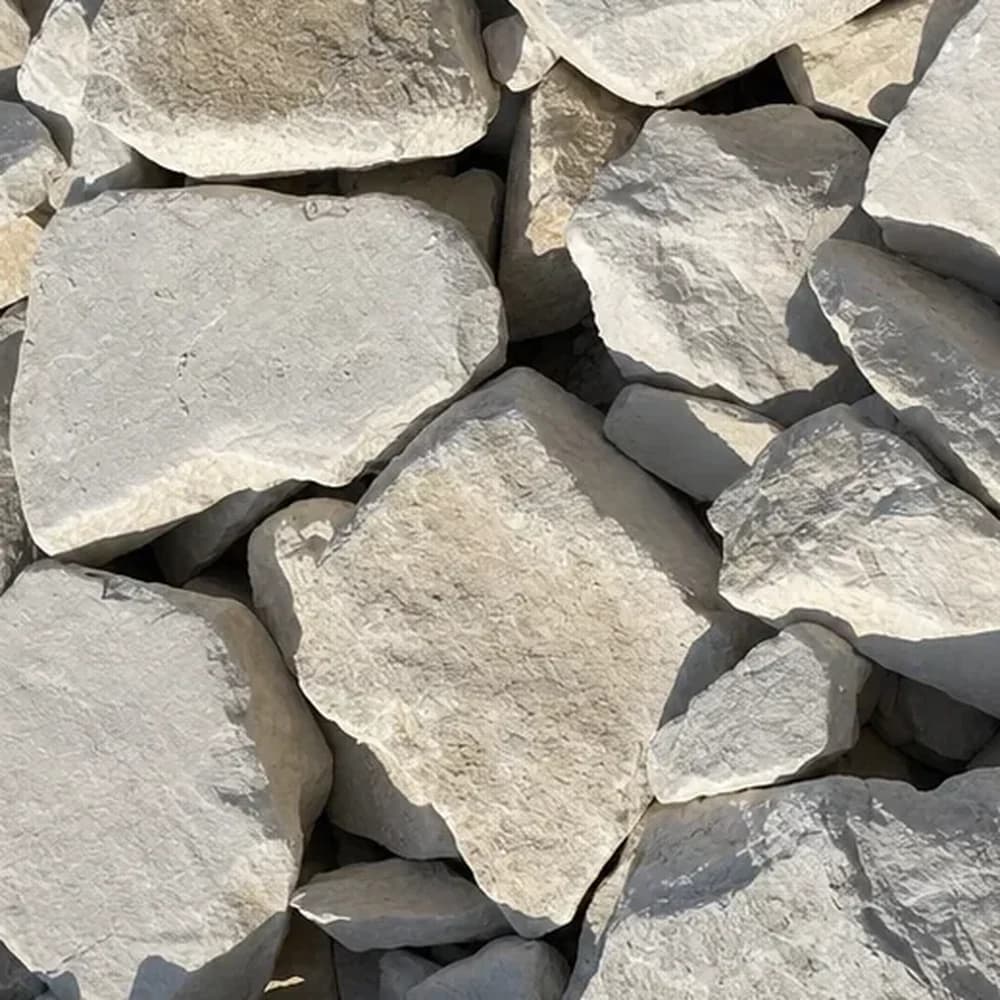
Rip Rap Calculator: Armor Stone by the Slope Face
Enter your project dimensions
The order that comes up short is almost always the one measured from the top of the bank looking down. A ditch bank in the till plains, a pond edge, a slip on a southeast hillside: the ground you are armoring is a slope, and a slope has more surface than the strip of map it sits on. That single mistake is what the rip rap calculator on this page most often has to undo, and the correction is worth several tons before anything else is decided.
Everything below follows one hypothetical job, a 50 ft run of scoured ditch bank with a 9 ft face.
Measuring Down the Bank Face, Not Across the Map
Put the tape on the ground and walk it from the toe of the bank up to the top, following the surface. That distance is your width. The run along the ditch or the shoreline is your length. For our bank that is 9 x 50 = 450 sq ft of face.
Measured the other way, from the top edge across to where the toe sits underneath, a bank shaped at 2:1 reads about 8 ft instead of 9. Run the numbers both ways at an 18 inch layer and the difference is 38.8 tons against 34.7, so the flat measurement leaves you four tons light on a job where running out halfway means the unarmored section scours in the next storm.
On a bank that is not a clean plane, split it into up to five areas and measure each stretch separately. Ditch banks change height along their run more often than they stay level.
Shaping the Slope and Anchoring the Toe
Cut the bank back to 2:1 or gentler before any stone arrives. Anything steeper than that is an engineering question and not a matter of throwing more rock at it, particularly on the clayey slope debris and soft shale of southeast Ohio and the Cincinnati river hills, where long wet spells set off slips whatever is sitting on the surface.
Then dig the toe in. The lowest course goes below the waterline or below the depth you expect scour to reach, because failure almost always starts at the bottom and works up. A layer that looks right across the face and stops short at the toe will undercut in the first real storm and slide.
Check what approval your state and local authorities require before stone goes in below the ordinary high water line of a ditch, stream, pond or lake. Work in and along a watercourse is commonly permitted work, what is required differs by waterbody, and this page cannot settle it for you.
Putting Fabric or #4 Stone Underneath
Armor rock laid straight on Ohio soil looks fine for a season, then the fines wash out through the gaps and the bank settles behind it. Under the rock goes either a non-woven geotextile, which comes from a landscape supplier rather than this catalogue, or a 3 to 4 inch bedding layer of #4 Crushed Stone.
That bedding is a second calculation on the same area. Our 450 sq ft face at 4 inches is 450 x (4 ÷ 12) = 150 cubic feet, which is 5.56 cubic yards, and at 1.45 tons per yard that is 8.1 tons of #4 stone. Size it on the stone calculator and order it with the armor so both are on site the day the machine is.
Running the Rip Rap Calculator at the Layer Thickness
Now the main figure. Enter the slope-face area, choosing a rectangle, a circle, or up to five areas added together. Length and width in feet, diameter in feet, depth in inches from 0.25 to 24. Select the material, tick the box that adds 5 percent for compaction and spillage, and calculate. You get cubic yards, tons and cubic feet at once, with an email option on the results panel.
Layer thickness is the field to think about. The working minimum is 12 inches, and the rule is one and a half to two times the largest stone, so 4 to 12 inch residential material usually takes 12 to 18 inches, and bigger stone or fast water takes 24. Note the ceiling: the depth field stops at 24 inches, so an engineered section thicker than that has to be run twice and the tons added.
Our ditch bank at 18 inches: 450 sq ft x 1.5 ft = 675 cubic feet, which is 675 ÷ 27 = 25.0 cubic yards, and at 1.55 tons per cubic yard, 38.8 tons. With the extra box, 40.7.
A culvert outfall on the same property, carried 8 ft downstream and 6 ft wide at 18 inches, is 48 sq ft: 48 x 1.5 = 72 cubic feet, 2.67 cubic yards, 4.1 tons. Carry an apron four to six pipe diameters past the outlet, because that is where the scour hole forms.
Keying the Rock Together as It Comes Off the Truck
Stone that stops where it rolled is not armor, it is a pile on a slope. Set the exposed course so the pieces key against each other, by machine or by hand, working from the toe upward.
Plan the drop before you order. A tandem load of armor stone is a small heap and a large weight, and the last 20 ft of track down to a pond edge is where a truck bogs. Moving 39 tons twice is a day nobody budgeted. Pick firm ground within machine reach of the toe, and if the approach is soft, say so on the contact page before the delivery date. Delivery is arranged at checkout by ZIP code, and the delivery notes cover what the driver needs at the tipping spot.
After the first heavy storm, walk it. Look for toe stones that have shifted, bare soil showing between rocks, and exposed fabric at the edges. Put the strays back, spread reserve stone over anything thin, and check the outfall for a scour hole. Ten minutes twice a year is the whole maintenance routine.
Why the Tons Line Reads 1.55 and the Yards Line Still Counts
Volume is the same arithmetic as every other tool here: area in square feet, times depth in inches divided by 12, divided by 27. Tonnage is where armor stone separates itself. RipRap weighs about 3,100 lb per cubic yard, or 1.55 tons, the heaviest figure this site publishes, which is why a 12 inch layer covers only about 17 sq ft to the ton.
Both outputs earn their place. Tons is what the product page charges in and what the truck is loaded to. Cubic yards is what tells you how much ground the heap will take up and how far a machine has to carry it, and on a job measured in dozens of tons that is the number that decides where the load goes. For a gentler job, Large River Rock armors a dry creek bed at 1.35 tons per yard, which is a different order of stone and a different order of water.
Common questions
Armor stone is placed rather than poured. Does that put the tonnage out?
Close on a bank you have shaped and measured, looser on one you have not. Armor stone is placed, not poured, so voids between big pieces mean the real requirement drifts either side of the figure depending on how tightly the exposed course is keyed. Measure the face in sections rather than as one average, and treat the result as a load to order against rather than a precise count.
Does the #4 bedding come from a second product page, or is it on the RipRap one?
The RipRap product page for the armor itself, and #4 Crushed Stone for the bedding layer underneath if you are not using fabric. Order both together so the bedding is down before the armor arrives, since placing armor first and trying to work bedding in afterwards does not happen.
The ditch bank job comes to 39 tons. What does a heap that size need from the drop spot?
Somewhere firm, within machine reach of the toe, and not on the slope you are about to armor. A ton of rip rap is around two thirds of a cubic yard, so 39 tons is roughly 25 yards of heap, which needs more room than a parking space and needs ground that will carry a loaded truck. Check the last stretch of the approach in person before you book the date.
Tons is the selling unit, so what is the cubic yards line for on a bank job?
Because they answer different questions. Tons is the selling unit and the truck's limit. Cubic yards tells you the size of the heap and how many machine buckets it is, which on a bank job is what your day is actually made of. Both come from the same volume, converted at 1.55 tons per yard.
Do I measure the 18 inch layer from the bedding course or from the soil under it?
Loose, as placed. Armor stone is not compacted like a base course; it is set so the pieces bear on each other. Measure the thickness from the bedding layer to the top of the exposed rock, and keep it at one and a half to two times the largest stone. If you are between two size classes, take the larger stone and the thicker layer, because the extra weight is the margin.
Related calculators
Banks don't armor themselves.
RipRap by the ton with free delivery, plus the #4 bedding stone to go under it.