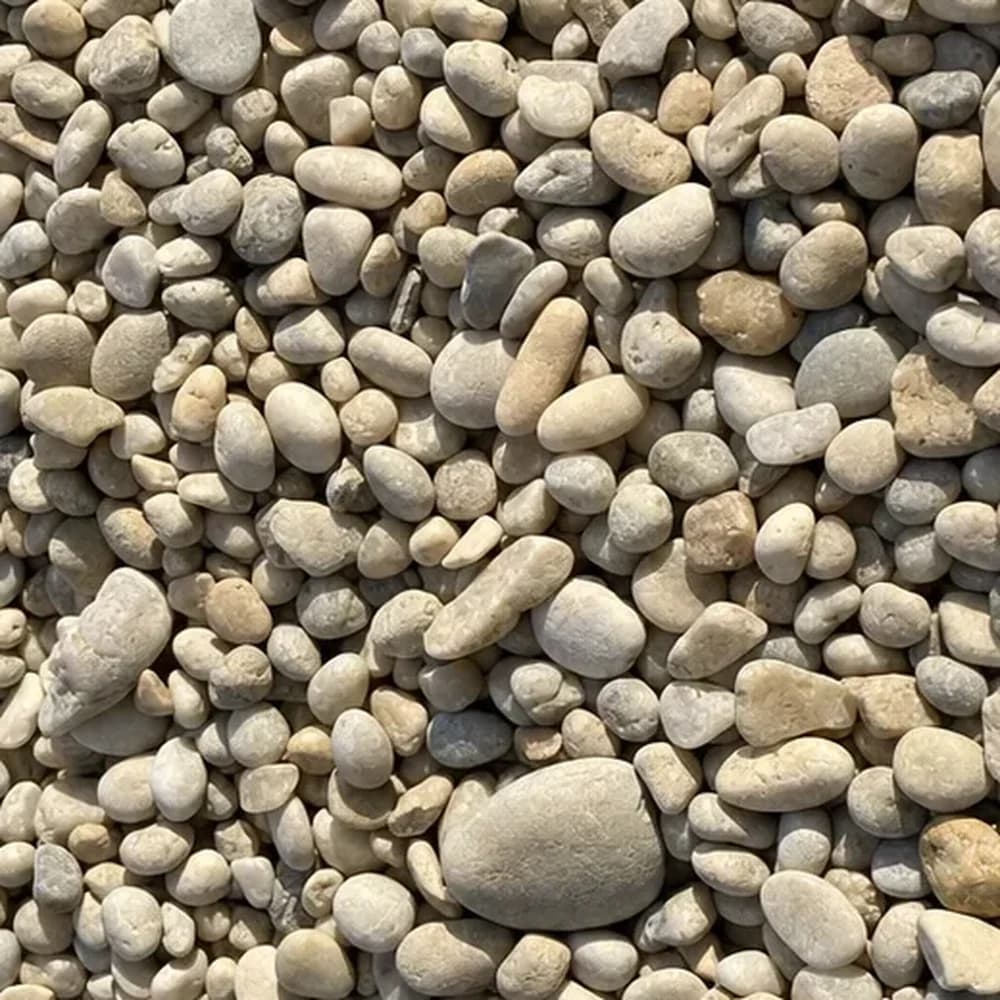
Pea Gravel Calculator: Tons for Seating, Paths and Play
Enter your project dimensions
The job that fills this page in Ohio is a back-garden seating area that has to cope with a freeze-thaw winter and a spring where the clay underneath stays saturated for weeks. Rounded 3/8 inch stone handles that better than most surfaces, since water runs straight through it and there is nothing rigid to crack. What it does not handle is being measured casually, because the shape is never a rectangle and the pea gravel calculator can only work with what you give it.
Pacing Out a Seating Area That Bends Around a Fire Ring
A gravel seating area usually has two straight sides against a fence or a wall and two edges that curve out into the lawn where the chairs go. There is no tape measurement that describes it honestly.
Box it. Drive a stake at the four outermost points and measure the rectangle they make. A patch that bulges to 16 ft at its widest and 11 ft deep goes in as 16 by 11, which is 176 sq ft. You have over-counted the corners and under-counted nothing, and the surplus goes into the traffic line in front of the chairs, which is the first place that thins out anyway.
Leave the fire ring itself in the measurement. A 4 ft ring is 12.6 sq ft of the 176, which at 3 inches is a few hundred pounds, and having it spare beats being short.
Three Shapes for the Pea Gravel Calculator, One Depth Box
Rectangle mode for a boxed area. Circle mode, entering the diameter in feet, for a fire pit surround or a round bed. Multiple areas, up to five added together, for a path that changes direction or a garden with more than one patch.
Length and width go in feet, depth in inches from 0.25 to 24. Pick the material so the tonnage matches the stone, tick the box that adds 5 percent for compaction and spillage, and calculate. Cubic yards, tons and cubic feet all come back, and the results panel will email the figures.
The 24 inch ceiling matters on one job only. A fall zone under play equipment wants 9 to 12 inches, which is well inside it, but any spec calling for more has to be entered as two runs and the totals added.
Two Inches for Walking, a Foot Under a Swing Set
Depth is the setting that decides whether the surface works, and pea gravel has a narrow band.
- Under 2 inches and the ground shows through inside a season, faster where Ohio freeze-thaw keeps working the layer.
- 2 to 3 inches is the working range for patios, paths, fire-pit surrounds and dog runs.
- Over 3 inches and walking on it feels like dry beach sand. Chairs sink and wheelbarrows bog.
- 9 to 12 inches for a playground fall zone, which is the one job outside the normal range. That depth, the fall-zone footprint and the maintained depth all come from the equipment manufacturer's instructions rather than from us, and what the tonnage buys is landscape pea gravel rather than certified playground surfacing.
Under a seating area on clay, put 2 inches of compacted Screenings down first and run the pea gravel 2 to 3 inches over it. Chair legs need something firm underneath, and on slow-draining till the compacted layer is also what stops the rounded stone working itself down into wet ground over a couple of winters.
Rounded Stone That Still Weighs 2,800 Pounds a Yard
Pea gravel feels soft underfoot and people assume it is light. It is not. The rounded shapes nest together with less void space than you would expect, so a cubic yard runs about 2,800 lb, or 1.40 tons per yard, the same figure this site publishes for crushed gravel and clean #57 stone.
| Depth | One cubic yard covers | One ton covers |
|---|---|---|
| 2 inches | 162 sq ft | about 116 sq ft |
| 3 inches | 108 sq ft | about 77 sq ft |
| 4 inches | 81 sq ft | about 58 sq ft |
| 12 inches, fall zone | 27 sq ft | about 19 sq ft |
Working the 3 inch line by hand: 27 cubic feet ÷ 0.25 ft = 108 sq ft, and 108 ÷ 1.40 = 77 sq ft to the ton.
For the boxed seating area above: 176 sq ft x (3 ÷ 12) = 44 cubic feet, which is 44 ÷ 27 = 1.63 cubic yards, and at 1.40 that comes to 2.3 tons, or 2.4 with the extra box ticked.
A Fall Zone and a Bending Side Path, With the Numbers
Two more hypothetical jobs, entered the way the tool wants them.
Swing-set fall zone, 17 by 14 ft at 10 inches. Area is 238 sq ft. Volume is 238 x (10 ÷ 12) = 198.3 cubic feet, which is 7.35 cubic yards, and at 1.40 that is 10.3 tons. The number surprises everybody. At a foot deep a ton covers about 19 sq ft, so a play area is not a bag-count job in any sense.
Side path that bends twice, at 2.5 inches. Use multiple areas: a 16 by 3 ft run is 48 sq ft, an 11 by 3 ft run is 33, and a 7 ft dogleg that widens to 3.5 ft is 24.5, for 105.5 sq ft total. Volume is 105.5 x (2.5 ÷ 12) = 22 cubic feet, or 0.81 cubic yards, which is 1.1 tons. Breaking the path into segments is far more accurate than measuring the straight-line distance between its two ends.
Edging Goes In Before the Stone Does
Round stone rolls, and a border that is missing or has sunk flush is behind almost every complaint about pea gravel wandering onto the lawn. Set steel, aluminum, timber or paver edging so it stands about an inch proud of the finished surface, and do it before the delivery rather than after.
Past roughly a 5 percent grade, edging alone stops being enough. Rain and foot traffic move rounded stone downhill regardless, so either lay a honeycomb stabilizing grid under it or switch to angular stone that locks. Walkway Gravel is the usual swap on a sloped Ohio side path, sized on the gravel calculator, while River Rock at 1.35 tons per yard suits a decorative border better than anything walked on and has its own river rock calculator. Run the same footprint through each tool and compare the tons line before you decide.
Once you have a figure, take it to Pea Gravel, set a quantity and a date. Delivery is arranged at checkout by ZIP code, and the driver needs clear access to a firm spot to tip the load, ideally on the edging side of the job rather than across it.
Common questions
Does the 5 percent box cover the settling on a new gravel patio?
It covers spillage and what stays in the heap, which on a two-ton order is real. Settling is a different thing. Rounded stone beds down into whatever is under it, so on bare clay expect to top up the traffic line after the first winter, and on a compacted screenings layer expect very little. If you are laying straight onto soil, order at the top of your depth range rather than the bottom.
The path runs down a bank to the shed. What length do I use?
Measure along the ground you will walk on with the tape following the slope, not the flat distance on a plan. Then think again about the material, because anything past a gentle grade will move rounded stone downhill whatever depth you order, and a stabilizing grid or angular stone is the fix rather than extra tonnage.
The dog run wraps round the corner of the garage in an L. How do I enter that?
Split it at the corner into two rectangles, use multiple areas, and count the corner square once. Enter the same depth on both so the tool totals a single surface. Five areas is the limit, which covers most gardens; beyond that, group the smallest patches into one rectangle of equivalent area.
Should the edging strip be inside the measured area?
Measure to the inside face of the border, because that is where the stone stops. Where there is no border yet, measure to where you intend to set one and order the edging for that line, since a flush or missing edge is what lets a season's worth of stone escape into the grass.
Do I need a base under it, and is that a second calculation?
On Ohio clay, yes to both for anything with furniture on it. Run the footprint once at 2 inches on screenings at 1.45 tons per yard for the compacted layer, then again at 2 to 3 inches on pea gravel at 1.40 for the surface. Two products, two tonnages, one delivery. A simple garden path over firm ground can skip the base layer.
Related calculators
Under two tons covers most patios.
3/8 inch natural pea gravel, priced by the ton, delivered free.