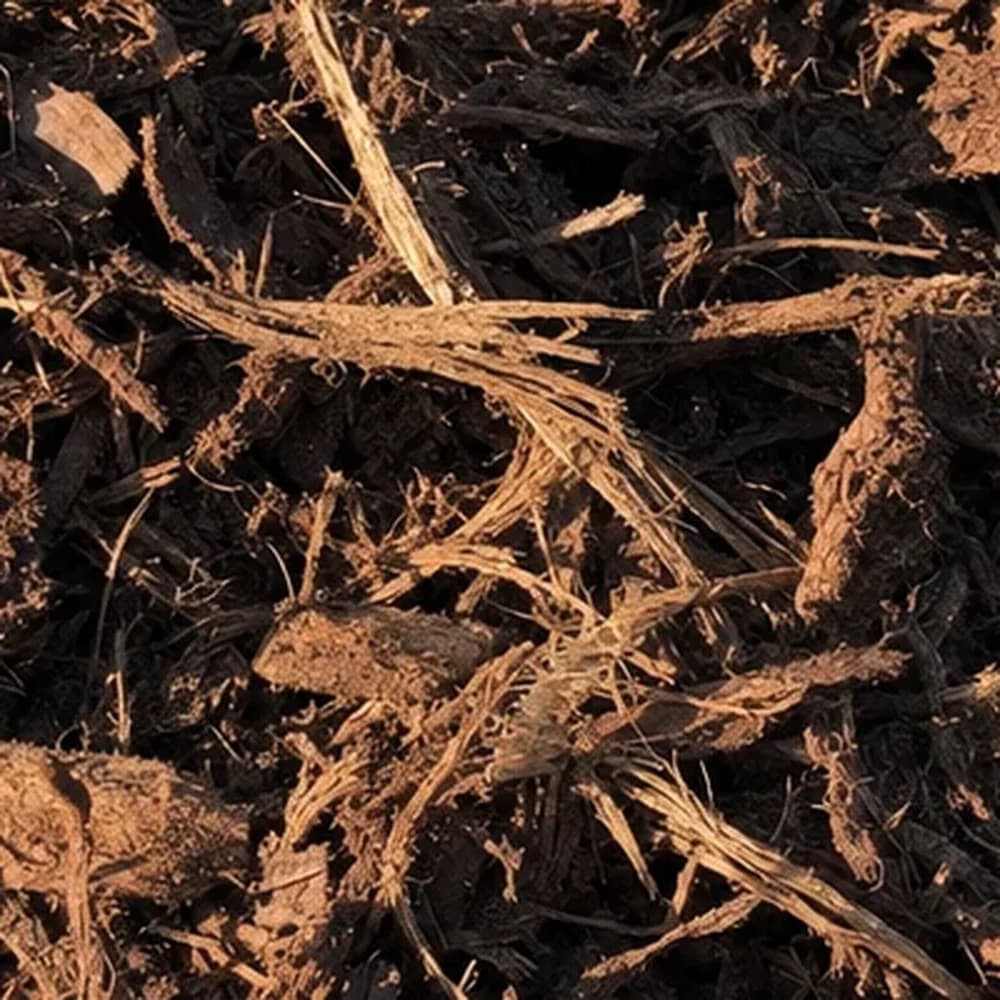
Mulch Calculator: Adding Up Ohio Beds and Tree Rings
Enter your project dimensions
The spring refresh is what brings most people to a mulch calculator, and in Ohio it waits on the same thing everything else waits on. Beds sitting on glacial clay stay cold and sodden until the ground drains, last year's layer mats down into a crust over winter, and the whole yard wants doing in one weekend once it finally dries. That is one order, and it is the sum of six or seven shapes that are nothing like rectangles.
Beds That Curve Around the House, Measured as Boxes
Nobody has a rectangular bed. What they have is a border that bulges at the corner of the house and tapers to nothing at the downspout, and a tape measure that will not follow it.
Take the length along the wall, then measure the bed's depth at its widest point and again at each end, and average the three. A border running 22 ft that is 5 ft deep in the middle and 2 ft at both ends averages 3 ft, so it goes in as 22 by 3 and 66 sq ft. The bit you over-measure on the outside curve is roughly the bit you under-measure on the inside one.
Round beds are easier: one measurement across the widest point, entered as a diameter in circle mode. A ring 4.5 ft across is 15.9 sq ft, not the 20.25 you would get by squaring the diameter.
What the Mulch Calculator Does With 27 Cubic Feet
It takes a rectangle, a circle, or up to five areas added together, which is the setting the spring refresh actually needs. Length and width in feet, diameter in feet, depth in inches from 0.25 to 24. Pick the material, leave the box that adds 5 percent for compaction and spillage ticked if you want a margin, and press calculate.
Back comes cubic yards, tons and cubic feet. For mulch the cubic yards line is the one that matters, because mulch is bought by volume. There is an email option on the results panel if you want the figure to hand when you order.
A cubic yard holds 27 cubic feet, which is the same volume as 13.5 bags of 2 cubic feet. That conversion is worth doing before a trip to the store rather than after it, since the arithmetic that says "a few bags" usually says something else once it is written down.
Two Inches Over Last Year, Three on Bare Soil
Depth in the box should be the depth of new material, not the finished total.
- Beds that already have mulch. Rake the old crust loose first, then add 2 inches over it. Bring the total to 2 to 3 inches, and no higher.
- Bare or newly planted beds. 3 inches. That is enough to slow weed germination and hold moisture through a dry July.
- Never more than 4 inches. A deep layer that stays wet on clay keeps air away from roots, and Ohio beds are already fighting slow drainage.
- Tree rings. Same 3 inches, in a flat donut, with 3 to 6 inches of clear ground left around the trunk. Mulch piled against bark rots it and gives voles somewhere to live.
- Along the house. Keep the material 6 inches clear of siding, below the slab line, and 2 to 3 inches deep at most.
Six Hundred Pounds a Yard, Which Is Why It Sells by Volume
Shredded hardwood runs about 600 lb per cubic yard, or 0.30 tons. Set that against the 3,000 lb a yard of 411 limestone weighs and the reason the two materials are sold in different units is obvious: a truck fills up on mulch long before it gets heavy.
| Depth | One cubic yard covers | Ten 2 cu ft bags cover |
|---|---|---|
| 1 inch | 324 sq ft | 240 sq ft |
| 2 inches | 162 sq ft | 120 sq ft |
| 3 inches | 108 sq ft | 80 sq ft |
| 4 inches | 81 sq ft | 60 sq ft |
Checking the 3 inch line: 27 cubic feet ÷ 0.25 ft = 108 sq ft. The bag column is the same sum with 20 cubic feet instead of 27.
A Front Border and Four Tree Rings, Added Together
Take a house with a foundation bed 34 ft long and 4 ft deep, plus four maples with 4.5 ft rings, all going in at 3 inches on bare soil, which is one depth and so one run. These are worked examples with invented dimensions.
The border. 34 x 4 = 136 sq ft. Volume is 136 x (3 ÷ 12) = 34 cubic feet, which is 34 ÷ 27 = 1.26 cubic yards, or about 17 bags. At 600 lb per yard that heap weighs roughly 755 lb.
The rings. A 4.5 ft circle is 15.9 sq ft, so four of them come to 63.6 sq ft. Volume is 63.6 x 0.25 = 15.9 cubic feet, which is 0.59 cubic yards, or about 10 bags.
Together that is 1.85 cubic yards, so order 2. The same house doing an annual refresh instead, roughly 480 sq ft of established beds at 1.5 inches, works out at 480 x 0.125 = 60 cubic feet, or 2.22 cubic yards, about 30 bags.
Where the Heap Goes When It Arrives
Three yards takes up about a parking space, so clear that much drive before the delivery date and put a tarp down first, because shredded hardwood stains fresh concrete. Delivery is arranged at checkout by ZIP code and the truck needs clear access to the spot where it will tip.
Then spread it inside a couple of weeks. A heap left standing a month heats in the middle and turns sour, and a wet Ohio May is exactly the weather for that. Budget 30 to 45 minutes of wheelbarrow work per yard, and keep the last half yard back for the beds behind the garage. Order Shredded Mulch by the yard, or open the calculator hub if the same trip also needs soil or stone. For a border you would rather not redo every April, River Rock covers the same ground and stays put, though it does nothing for the soil underneath it.
Common questions
Is ticking the 5 percent box enough of a margin for mulch?
For a straight-sided bed, yes, and it mostly covers what sticks in the wheelbarrow and blows off the heap. What it does not cover is a depth guess. If you meant 3 inches and spread nearer 3.5 across 500 sq ft you are a sixth over, which the box will not absorb, so measure a bed after the first wheelbarrow-load and check what you are actually laying down.
The bed is on a bank behind the wall. Do I use the slope length?
Use the distance measured up the face of the bank, not the flat distance across the garden, because the mulch has to cover the sloped surface. Also drop to 2 inches there. On a bank steeper than a gentle rise, shredded hardwood is the right pick since it knits together, and a heavy Ohio downpour will still float chips and nuggets off a slope.
My beds wrap the house on three sides. Do I have to add them up myself?
No. Use the multiple-areas option and enter each run as its own length and width, up to five at a time, and the tool totals them. Anything past five, group the smallest beds into one rough rectangle of the same total area. Keep the depth the same across all of them if they are getting the same treatment.
Does the strip of edging count in the measurement?
Measure to the inside face of the edging, not to its outer edge, since mulch that sits on top of a paver border or a steel strip is mulch on the lawn by July. Around a bed with no edging at all, stop the measurement where you intend the mulch to stop and accept that the boundary will need redrawing each spring.
I am adding new soil to the bed as well. One calculation or two?
Two, in two different tools. Soil and mulch weigh nothing like each other, so a single run at the combined depth would give a useless tonnage. Size the Garden Soil on the soil calculator, size the mulch here at 2 or 3 inches, and order both for the same delivery.
Related calculators
Skip the 27-bag cart.
Bulk shredded hardwood by the yard, tipped in your driveway, delivery free.